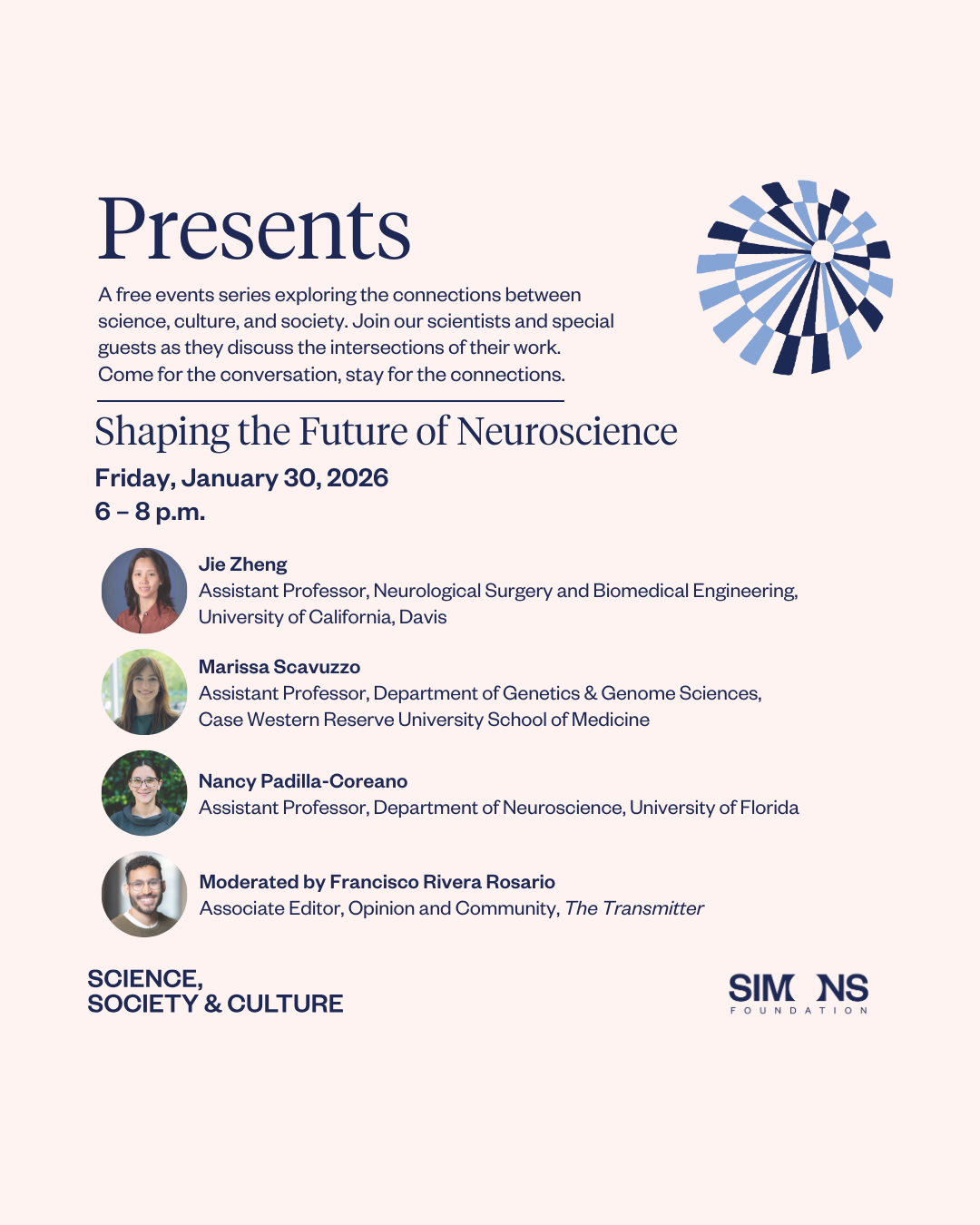


Simons Foundation Presents: Shaping the Future of Neuroscience
1/30
6:00 pm – 8:00 pm
What is consciousness? Can we find a cure for Alzheimer’s disease? Is the gut-brain link real? Neuroscientists around the world spend countless hours using cutting-edge techniques and experimental tools to answer these and other questions about the mechanisms that control the brain.
But neuroscience is a diverse field. Neuroscientists study everything from how our brain processes social interactions to how our memories form to why we need sleep. Given how there is still so much that we don’t know about the brain, how should the next generation of neuroscientists decide what to focus on? T
he Transmitter — an editorially independent publication of the Simons Foundation focusing on news and developments in neuroscience — recently showcased 25 early-career researchers who are tackling some of these major questions. Among these Rising Stars of Neuroscience are Nancy Padilla-Coreano, a researcher who studies the neurobiology of decision-making; Marissa Scavuzzo, who investigates nervous system cells in the gut; and Jie Zheng, who focuses on cognition and memory.
Join us as these three rising stars sit down with Francisco J. Rivera Rosario, associate editor, opinion and community at The Transmitter, for a conversation that will explore where the field of neuroscience is headed next and how their work is helping to drive it forward.
Registration opens 3 weeks before the event and closes at 2PM day-of. Review the full list of registration & entrance requirements below.
ABOUT THE SPEAKERS
Zheng is an assistant professor in neurological surgery and biomedical engineering at the University of California, Davis. Her research uses cutting-edge single-neuron recordings in humans to explore how the human brain encodes and retrieves memories. With a background in electrical engineering and a Ph.D. in biomedical engineering, she bridges the fields of engineering and neuroscience to uncover the neural basis of human cognitive functions. Zheng is a recipient of the NIH BRAIN Initiative Advanced Postdoctoral Career Transition Award to Promote Diversity and serves as associate editor for Frontiers for Young Minds, where she promotes science communication to young audiences.
Scavuzzo is a neuroscientist and faculty member at the Case Western Reserve University School of Medicine in the Institute for Glial Sciences. Her lab studies the enteric nervous system, known as the “brain inside your gut,” a diverse cellular network in the gut that regulates digestion. She and her team develop new cellular and genetic approaches to study these complex cells, creating a framework to understand their diversity and roles in both gut and neurological health and disease. Beyond her research, Scavuzzo is deeply committed to mentorship, equity in science and open collaboration to ensure discoveries are accessible to all.
Padilla-Coreano is a neuroscientist and assistant professor at the University of Florida, where she leads the Padilla-Coreano Lab, studying the neural circuits and dynamics that support social competence and how they are altered in disease. Padilla-Coreano earned her undergraduate degree from the University of Puerto Rico, Río Piedras, and her Ph.D. at Columbia University. She completed postdoctoral training at MIT and the Salk Institute. Her work has been recognized with awards from the NIH BRAIN Initiative, the Simons Foundation and the L’Oréal Women in Science Fellowship. She is passionate about amplifying the voices of young scientists whose backgrounds have been historically underrepresented in research. She is a cofounder of Stories of Women in Neuroscience, which produces interviews and profiles of women in neuroscience research in English and Spanish.
Flatiron & NoMad Businesses: Have an event to add? Submit it here